
Vivaldi’s Gloria received its first performance in modern times in September 1939 in Siena, Italy. After Vivaldi’s death in 1741 the work had been forgotten for 200 years.
The performance took place as part of the first “Settimana Musicale Senese” (“Sienese musical week”) in September 1939, when several other works by Vivaldi were also reintroduced to the world. The performance took place at the basilica of Santa Maria dei Servi in the contrada of Valdimontone, one of the 17 “parishes” of Siena.
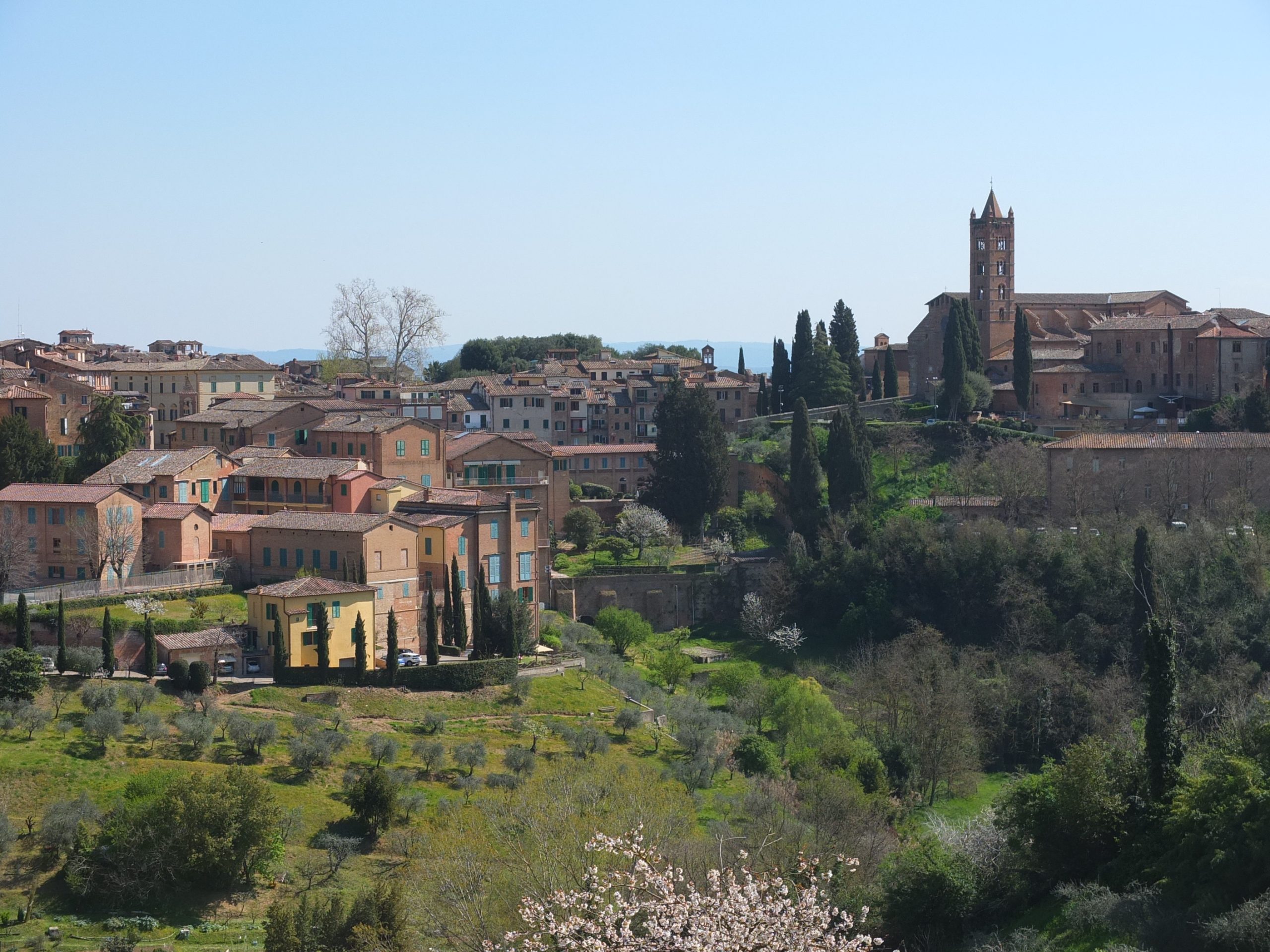
The church of Santa Maria dei Servi, Siena (photo Tim Ault)
These historic performances took place thanks to the work of a group of friends and lovers of baroque music. The founder of the group was the Italian composer and performer Alfred Casella. Other members included the American poet Ezra Pound, the young American violinist, Olga Rudge and the Sienese music lover count Guido Chigi Saracini.
In 1936 Ezra Pound managed to obtain 79 microfilms of Vivaldi’s compositions held by the State Library of Saxony in Dresden and another 309 compositions from the Royal Library of Turin. Thanks to the meticulous work of Olga Rudge, the first Thematic catalog of Antonio Vivaldi’s instrumental works was published by the Accademia Musicale Chigiana, and the rediscovery of the works of the “Red Priest” began. A complete catalogue was published between 1974 and 2007 by Peter Ryom. – RV refers to this.
The works performed in the first Sienese Musical week were:
- The opera L’Olympiade – chosen both for the beauty of the music and for the libretto BY THE POET Pietro Metastasio. Some movements from another opera La Dorilla were also included
- Four of Vivaldi’s sacred works: Credo (RV 592), The Motet (RV 631), the Stabat Mater (RV 621) and the Gloria (RV 589)
- Several concertos : the concerto for two violins and strings (RV 523), the concerto for strings “Il reposo”, (“the rest”) (RV 270) the Alla Rustica (RV 151) and the concerto for flute and strings “La notte” (“The night”) (RV 439)
- A curious piece of chamber music was performed, a “Serenata a tre” – “Serenade for three”, for three voices, choir and small instrumental ensemble
- Some opera arias and transcriptions from J.S.Bach were also performed including the Organ Concerto (BWV 596) taken from Vivaldi’s Concerto for Two Violins (RV 565) and the Concerto for Four Harpsichords (BWV 1065) taken from Vivaldi’s Concerto for Four Violins (RV 580).
In subsequent years the Settimana Musicale Senese brought to light music by other composers of the 18th century including Domenico and Alessandro Scarlatti, Andrea and Giovanni Gabrieli, Claudio Monteverdi, and (names less familiar perhaps outside Italy), Giuseppe Torelli and, Baldassarre Galuppi.
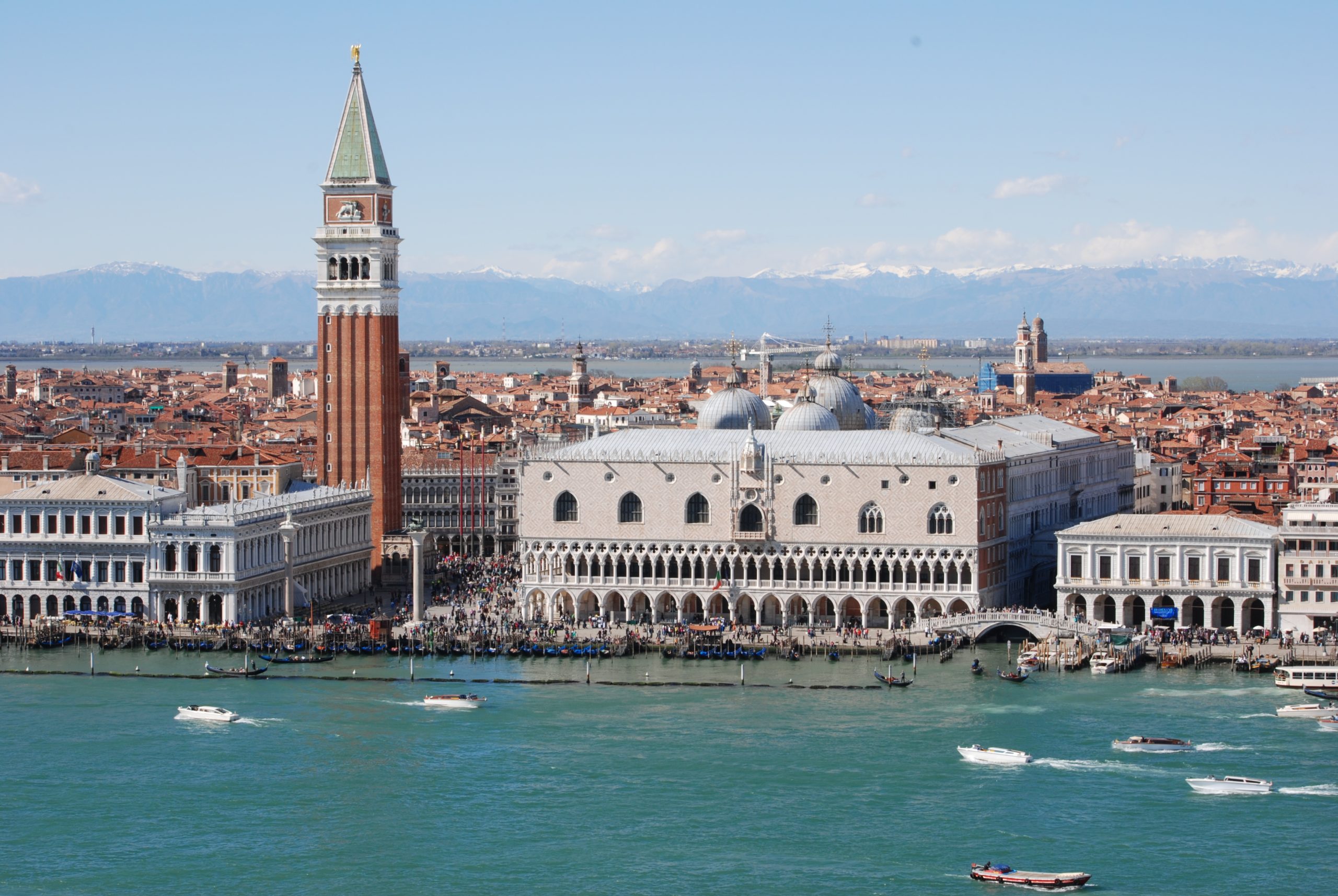
Venice – the doge’s palace and St Mark’s Square (photo Tim Ault)
Count Guido Chigi Saracini
None of this would have been possible without the patronage and support of count Guido Chigi Saracini. Count Chigi came from an eminent Sienese family and studied music as a young man. After inhertiing a fortune from his uncle, he was able to pursue his wish to put Siena on the international musical map, and to make it possible for performances of neglected works to take place. In 1923 he founded a concert series called “Micat in Vertice” “it shines on high”, which took its name from the motto of the Chigi Saracini Lucherini family. In 1932, he established the Accademia Musicale Chigiana (Chigi Music Academy) which is based in the Chigi Saracini Palace in the historic heart of Siena. In Siena it is known simply as “La Chigiana”.
A plaque in the palace courtyard commemorates the event:
IN QUESTA SEDE DELL’ACCADEMIA MUSICALE CHIGIANA LA GLORIA DI ANTONIO VIVALDI «MUSICO VENETO» FU RIVENDICATA DOPO DUE SECOLI QUANDO NEL SETTEMBRE 1939 PER VOLONTÀ DEL CONTE GUIDO CHIGI SARACINI NACQUERO LE SETTIMANE MUSICALI SENESI.
HERE AT THE SEAT OF THE ACCADEMIA MUSICALE CHIGIANA THE GLORY OF THE VENETIAN MUSICIAN ANTONIO VIVALDI WAS ACKNOWLEDGED AGAIN AFTER TWO CENTURIES WHEN IN SEPTEMBER 1939 THE SIENESE MUSICAL WEEKS WERE INITIATED BY COUNT GUIDO CHIGI SARACINI
Acknowledgements :
Much of the information above comes from this article by Felicita Pacini. My thanks to her.
Find out more:
The story of the discovery of the manuscripts in Turin
Discovering the Rediscovery of Antonio Vivaldi” by Miles Dayton Fish, and a useful chronology
More about Vivaldi and the Ospedale della Pietà including eyewitness reports
Tim Ault June 2023